Magnetic Tiles NZ: 10 Creative Ways Kids Can Learn Through Building
Magnetic TilesShare
Quick Answer
Magnetic tiles are not just a plaything but offer children an avenue of learning while playing that helps them develop skills such as creativity, problem-solving, spatial understanding, mathematical reasoning, communication, and fine motor skills. From stacking up towers, bridges to making patterns or worlds, magnetic tiles allow kids to explore, make mistakes and retry.
If you wish to buy magnetic tiles NZ, then they will help enhance your kid’s experience in a wide range of learning environments.
Table of Contents
- Why Do Kids Learn Through Building?
- 10 Creative Ways Kids Can Learn Through Magnetic Tiles
- How Parents Can Make Magnetic Tile Play More Educational
- Magnetic Tiles for Different Ages
- FAQs
Why Do Kids Learn Through Building?
Playing is part of the learning process for kids. When they use magnetic tiles to construct something, they don’t just attach brightly colored pieces together; they experiment with concepts, make choices, make observations, and alter their construction accordingly.
If a tower collapses, it becomes a lesson in equilibrium. If a bridge doesn’t connect, it becomes a problem to solve. If you construct a house, it becomes shapes, design, space, and storytelling.
That’s why magnetic tiles are considered a great open-ended learning toy since there is only one right way of playing with them.
Parents looking for magnetic tiles NZ can purchase the open-ended set of toys and thus allow children to repeat playing with them again and again while getting better at it.
10 Creative Ways Kids Can Learn Through Magnetic Tiles
1. Build Towers to Explore Balance and Stability
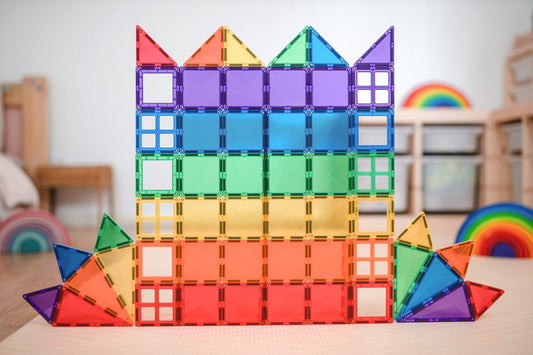
Challenge your kid to construct the tallest tower he or she can.
During the process, kids start realizing that some towers are more stable than others. Kids may realize that some structures require a wide base, while others tend to fall because there are too many blocks on one side.
Some of the early ideas this activity provides include:
- Balance
- Stability
- Distribution of weight
- Cause and effect
- Engineering
Challenge: Challenge your kids to build a tower using a certain number of blocks.
2. Create Shapes and Learn Early Geometry
Magnetic shapes help abstract geometry become concrete.
Kids can recognize squares, triangles, rectangles and other shapes as they construct them to make a bigger shape. Older kids can work on learning things like sides, angles, symmetry, and 2D vs 3D shapes.
Rather than just learn the names for geometric shapes, kids can actually visualize and play with the shapes.
Example: “How many triangles will you need for that roof?” or “Can you make a cube from these pieces?”
3. Practise Counting and Early Maths
Magnetic tiles games can very easily turn into math activities.
Children can count the number of magnetic tiles they are using, compare the height of different towers built from the magnetic tiles, classify them according to their colors or shapes, and even form repeating patterns.
Some of the mathematical vocabulary that you can introduce to children is:
- More and less
- Bigger and smaller
- Taller and shorter
- Equal and unequal
- Before and after
Activity for parents: give your child 20 tiles and ask him/her to classify them according to their shape or color.
4. Develop Spatial Awareness
Spatial awareness involves understanding the position of an object relative to other objects.
Building with magnetic tiles requires the child to be continuously thinking about positioning, direction and space, and realizing that changing the position of a particular piece will affect its fit, and moving one structure affects another.
It may help develop some skills which are needed in tasks like drawing, construction, math, and map reading in future.
Exercise: Provide your child with a certain structure, and ask him to replicate it using the same pieces.
5. Encourage Problem-Solving and Critical Thinking
One of the advantages of playing with magnetic tiles is the constant presence of minor problems that kids face.
- "Whay did my roof fall down?"
- "How can I extend this bridge?"
- "Why do these elements connect the way I need?"
Let the kids find the solution on their own instead of instantly solving the issue.
They gain experience in making predictions, trying different solutions and altering the method when it doesn't work.
It's a natural entry into the world of STEM through play.
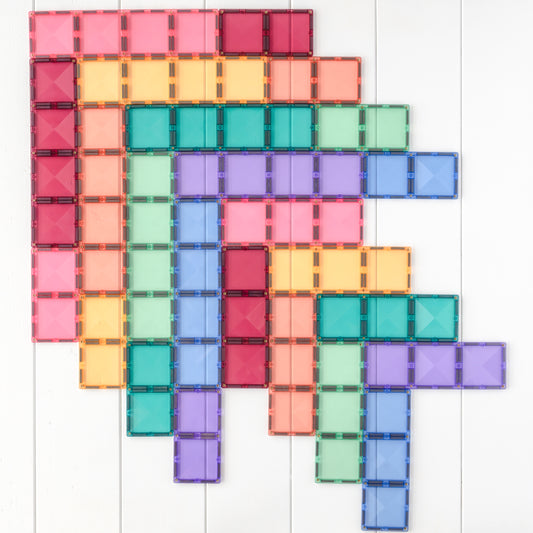
6. Explore Colours, Patterns and Sorting
Using colourful magnetic tiles makes a building time into an early learning experience.
Children can be asked to form patterns like red-blue-red-blue or yellow-green-green-yellow. Children can also be made to sort the tiles based on their colours, shapes, or sizes.
In younger children, it helps in the identification of colours and sorting while older children can make complicated patterns along with explaining the rule.
Give this a try: Form a pattern and have your child guess what follows next!
7. Build Real-World Structures
Encourage children to recreate familiar buildings and objects.
They could build:
- A house
- A school
- A bridge
- A garage
- A castle
- A shop
- A farm
- A playground
This connects imaginative play with the real world.
You can also ask questions about why buildings have doors, windows, roofs and walls. Children can begin thinking about how structures are designed for different purposes.
For NZ families, you could even challenge children to build a New Zealand-inspired structure, such as a beach house, farm, lighthouse or imaginary Kiwi wildlife centre.
8. Develop Fine Motor Skills
Manipulation of magnetic blocks is dependent on controlled movement of hands.
The activities may be beneficial in helping kids practice:
- Eye-hand coordination
- Grasping and control
- Precision
- Bilateral coordination
- Fine motor skills
Children at a younger age might take some time to comprehend the process of connecting the magnetic blocks. Through practice, they tend to gain confidence as builders.
9. Turn Building Into Storytelling
Construction is not limited to the point that a building is completed.
Invite your child to develop a story based on the structure he or she has created.
In case of a castle, who stays inside? In case of a store, what does it sell? In case of a space ship, where is it going to?
This merges construction with language acquisition and imagination.
Moreover, children can learn sequencing through their story telling, as they describe the events in order.
10. Encourage Collaboration and Communication
Magnetic tiles are great for cooperation games.
Children could build a structure together in a team, but they need to talk to each other, share their tiles and decide what to make.
It will help develop the following useful social skills, such as:
- Turn-taking
- Listening
- Sharing
- Negotiation
- Explaining ideas
- Collaborating toward a common goal
Adults can get involved in the game too. Instead of building by yourself, you should just ask questions and let your child be in charge.
How Parents Can Make Magnetic Tile Play More Educational
Every playtime does not have to be converted into a learning experience.
The most effective way would be to follow the interest of your child and raise open-ended questions to him/her.
For instance, instead of saying, “Make a triangle,” you can say:
- “What do you think you could make using these three pieces?”
- Instead of repairing the tower for your child, you can say:
- “What do you think might have made it collapse?”
- Some other examples of such questions could be:
- “What do you think could make it more stable?”
- “How many tiles have you used?”
- “Can you make one like that?”
- “What would happen if we widen the bottom?”
- “Could you make something which holds this toy?”
- “Can you tell me how you made it?”
Magnetic Tiles for Different Ages
The magnetic tiles activities may be modified depending on how kids grow up.
3 to 4 years: Focusing on shapes, colors, stacking, matching, and construction.
5 to 6 years: Adding in patterns, counting, structures, story-telling, and challenges.
7 to 8 years: Creating complicated designs, symmetry, measurement, engineering challenges, and collaborations.
Be sure to choose the magnetic tiles suitable for a child’s age and designed safely.
FAQs
1. Are magnetic tiles educational?
Yes, because they can contribute to learning in fields such as early math skills, spatial skills, creativity, problem solving, fine motor development and communication, among others, since they are very flexible and can be used by kids for different purposes while they are growing.
2. What can children learn from magnetic tiles?
Children can learn concepts related to shapes, patterns, numbers, balance, building, spatial relationships, and cause and effect, among others. Playing with magnetic tiles can stimulate kids' creativity, critical thinking, and teamwork.
3. Are magnetic tiles good for STEM education?
Yes, because through building activities kids can have a natural exposure to STEM subjects like engineering, geometry, measurement, balance, and problem-solving.
4. At what age can magnetic tiles be used?
Magnetic tiles come in many ages but can differ depending on the particular item and instructions provided by the maker. Make sure you consider the recommended age and safety information of the magnetic tiles before giving them to your kid.
5. Where can I purchase magnetic tiles in NZ?
Parents can find age-specific magnetic tiles in New Zealand at specialized toy stores and online stores. Make sure the toys have quality materials and age recommendations, and come in a set with sufficient variety of shapes.
Build, Play and Learn With Magnetic Tiles
The biggest advantage of magnetic tiles is their flexibility. One set can become a maths activity in the morning, an engineering challenge in the afternoon and an imaginative story in the evening.
For children, it simply feels like play. But while they are connecting pieces, testing structures and creating new ideas, they are also developing valuable skills.
Whether your child is building a simple tower or an entire imaginary city, magnetic tiles in NZ can provide an engaging way to combine creativity, learning and hands-on exploration.