Magnetic Blocks: The Complete Guide for Kids in New Zealand
Magnetic TilesShare
Quick Answer:
Construction sets which include magnetic blocks are a form of educational toys using magnets to join together pieces to make two-dimensional and three-dimensional structures. They promote free play and aid in the development of creativity, problem solving, spatial understanding, fine motor skills and basic STEM knowledge.
Magnetic blocks have emerged as a favorite among parents who seek toys that are both entertaining and educational. Whereas many toys serve only one particular function, magnetic blocks can be used to construct houses, towers, cars, castles, animals and even almost anything you can think of.
They also offer New Zealand families an opportunity for some screen-free fun at home.
Table of Contents
- What Are Magnetic Blocks?
- How Do Magnetic Blocks Work?
- What Are the Benefits of Magnetic Blocks for Kids?
- Magnetic Blocks vs Traditional Building Blocks
- What Can Kids Build With Magnetic Blocks?
- How to Choose the Best Magnetic Blocks
- Are Magnetic Blocks Safe for Kids?
- Magnetic Blocks for Different Ages
- Why Are Magnetic Blocks Good for Screen-Free Play?
- Magnetic Blocks as a STEM Toy
- Tips for Making Magnetic Block Play More Educational
- Where to Buy Magnetic Blocks in New Zealand?
- Conclusion
- FAQs
What Are Magnetic Blocks?
Magnetic blocks are construction pieces made up of magnets within them. The magnetic attachments make it possible for kids to put pieces together without using clips, glue, or other tools.
Depending on the particular construction set, magnetic blocks could have:
- Squares
- Triangles
- Rectangles
- Hexagons
- Windows
- Arches
- Wheels
- Other special construction pieces
Kids can use various shapes to construct flat designs or three-dimensional constructions.
The magnetic attachment makes it quite easy for kids to construct things even if they are still learning how.
How Do Magnetic Blocks Work?
Magnetic blocks work through magnets embedded inside or around each building piece. When compatible pieces are placed together, the magnets attract and hold the pieces in position.
This simple mechanism gives children the freedom to experiment with different designs.
For example, a child might start by making:
Square → Wall → Tower → House → Castle → Complete City
As children experiment, they naturally encounter concepts such as balance, symmetry, shape, size and stability.
This type of hands-on building also connects with the broader benefits of block play identified by New Zealand's Ministry of Education, including learning about gravity, balance, weight, shapes, space and trial and error.
What Are the Benefits of Magnetic Blocks for Kids?
1. Encourage Creativity and Imagination
There is no one right way to work with magnetic blocks.
The same set could become a castle today and a spaceship tomorrow. This approach allows for creative thinking and not just following the rules set by others.
2. Develop Problem-Solving Skills
Not every structure will work on the first attempt.
A tower might fall, a bridge might be unstable or a roof might not fit correctly. Children can test different solutions and rebuild their designs.
This process encourages persistence and problem-solving.
3. Support STEM Learning
STEM concepts can be taught to children using magnetic blocks via play.
They can learn about:
- Geometric shapes and geometry
- Patterns
- Symmetry
- Balance
- Gravity
- Measurements
- Structure
- Cause and effect
The same is emphasized by the New Zealand Ministry of Education in relation to introducing mathematical and scientific concepts using block play.
4. Help Develop Fine Motor Skills
Movement of hands to join, separate and position small building parts should be controlled.
Building exercises enable children to practice:
- Hand-eye coordination
- Grip control
- Precision
- Finger movements
- Visuo-spatial coordination
5. Encourage Independent Play
Magnetic blocks don't always require an adult to explain what to do.
Children can choose their own project, experiment with different shapes and decide how they want their final structure to look.
This makes magnetic blocks useful for independent, self-directed play.
6. Encourage Social and Collaborative Play
Magnetic blocks can also become a group activity.
Two or more children can work together to build a large city, race track, castle or other structure. This encourages communication, cooperation and sharing.
Block play can provide opportunities for children to discuss ideas and collaborate with others.
Magnetic Blocks vs Traditional Building Blocks
Both traditional blocks and magnetic blocks can provide valuable building experiences, but the construction experience is different.
| Feature | Magnetic Blocks | Traditional Blocks |
|---|---|---|
| Connection | Magnetic | Stack or balance |
| 3D building | Easy to experiment with | Requires balancing |
| Creativity | High | High |
| STEM learning | Yes | Yes |
| Fine motor practice | Yes | Yes |
| Open-ended play | Yes | Yes |
| Beginner friendly | Often easier | Depends on the set |
Magnetic blocks can be particularly appealing to children who enjoy creating structures that connect together quickly.
What Can Kids Build With Magnetic Blocks?
One of the biggest advantages of magnetic blocks is the number of possible creations.
Try these ideas:
1. Houses
Build walls, doors and roofs to create a simple house.
2. Castles
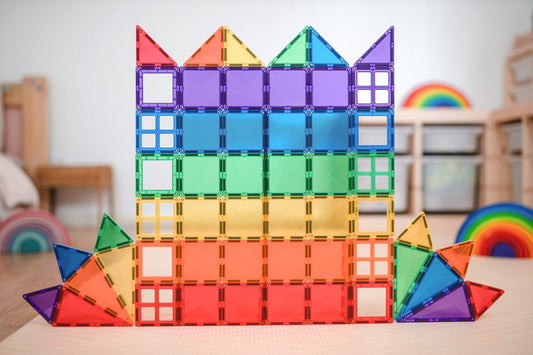
Use triangles and squares to create towers, walls and castle roofs.
3. Bridges
Challenge children to build a bridge strong enough for a toy car to cross.
4. Vehicles
Combine magnetic pieces with compatible wheels or vehicle accessories to create cars and trucks.
5. Cities
Build several structures together and create an imaginary city.
6. Spaceships
Ask children to design a spaceship and explain where it is travelling.
7. Animal Shapes
Use different geometric pieces to experiment with simple animal-inspired designs.
These activities turn magnetic blocks into more than just a construction toy they can become part of storytelling, maths activities and imaginative play.
How to Choose the Best Magnetic Blocks
When buying magnetic blocks in New Zealand, consider these factors.
Age Recommendation
Always check the manufacturer's recommended age before buying a set.
Many magnetic building sets are designed for children aged 3+, but recommendations vary by product. Some products also contain small parts and require adult supervision.
Number of Pieces
A smaller set can be ideal for beginners.
Larger sets provide more pieces and therefore more possibilities for complex structures.
For example:
- Small sets: Good for first-time builders
- Medium sets: Suitable for regular building
- Large sets: Better for bigger structures and multiple children
Shape Variety
Look for sets containing different shapes rather than only squares.
Triangles, rectangles, windows, wheels and other pieces can significantly expand building possibilities.
Magnet Quality
The magnets should be securely enclosed within the pieces and designed according to the manufacturer's safety requirements.
Always inspect magnetic pieces regularly for damage.
Compatibility
If your child already owns magnetic tiles or building pieces, check whether the new set is compatible before purchasing.
Some magnetic building systems are designed to work with other compatible products, while others may use different dimensions or connection systems.
Are Magnetic Blocks Safe for Kids?
Magnetic blocks can be suitable for children when used according to the manufacturer's instructions and age recommendations.
However, magnets require particular care. Damaged toys should not be used, and children should never be allowed to access loose magnets.
Always:
- Follow the manufacturer's age recommendation
- Check pieces regularly for damage
- Keep damaged pieces away from children
- Supervise younger children when appropriate
- Follow all safety instructions
- Keep loose magnets away from children
Some magnetic toy products specifically warn about choking hazards and the serious risks associated with swallowed magnets.
Magnetic Blocks for Different Ages
Ages 3–4
Choose simple sets with larger, easy-to-handle pieces and straightforward shapes.
- Focus on activities such as:
- Colour matching
- Simple towersFlat patterns
- Basic houses
Ages 5–6
Children can begin experimenting with more complex structures.
Try:
- Bridges
- Castles
- Vehicles
- Towers
- Pattern challenges
Ages 7+
Older children can use larger sets for more challenging engineering-style projects.
Try asking them to:
- Build the tallest stable tower
- Create a bridge
- Design a complete city
- Build a symmetrical structure
- Recreate a picture using blocks
Why Are Magnetic Blocks Good for Screen-Free Play?
One of the biggest advantages of magnetic blocks is that they give children something hands-on to explore.
Instead of watching a finished construction on a screen, children actively decide what to build, test their ideas and change their designs.
This combination of creativity, experimentation and physical interaction makes magnetic blocks a useful option for screen-free play.
Magnetic Blocks as a STEM Toy
Magnetic blocks can introduce STEM ideas without making learning feel like a lesson.
For example:
Science: What makes the structure fall?
Technology: How can different pieces work together?
Engineering: How can you make the bridge stronger?
Mathematics: How many triangles are needed to create the roof?
This approach allows children to learn through experimentation and play.
Tips for Making Magnetic Block Play More Educational
Parents can make building activities more engaging by asking simple questions.
Instead of saying:
“Build a house.”
Try asking:
- “How can you make the house taller?”
- “What can you do to make the tower stronger?”
- “How many triangles did you use?”
- “Can you build a bridge for this car?”
- “Can you make both sides symmetrical?”
- “What happens if you change the shape of the base?”
These questions encourage children to think about their designs rather than simply completing a structure.
Where to Buy Magnetic Blocks in New Zealand?
Magnetic blocks are available from a variety of New Zealand toy retailers and online stores. When shopping, compare the piece count, age recommendation, materials, magnet design, shapes and compatibility rather than choosing based only on price.
For families looking for magnetic building toys, a quality set can provide long-term value because children can create increasingly complex structures as their confidence develops.
Conclusion
Magnetic blocks are more than just building toys. They provide children with an open-ended way to create, experiment and learn through hands-on play.
From developing creativity and fine motor skills to introducing geometry, balance and problem-solving, magnetic blocks can support a variety of learning experiences.
For New Zealand parents, the best set will depend on the child's age, interests, experience and preferred style of play. Choose a safe, age-appropriate set with enough shapes and pieces to encourage creativity, and let your child take the lead.
FAQs
1. What are magnetic blocks?
Magnetic blocks are construction toys with magnets that allow children to connect pieces and create different 2D and 3D structures.
2. Are magnetic blocks educational?
Yes. Magnetic blocks can support creativity, problem-solving, spatial awareness, fine motor skills and early STEM learning through hands-on play.
3. What age are magnetic blocks suitable for?
Many magnetic building sets are recommended for children aged 3 and above, but parents should always follow the specific manufacturer's age recommendation.
4. What can kids build with magnetic blocks?
Children can build houses, castles, towers, bridges, vehicles, cities, patterns and many other imaginative structures.
5. Are magnetic blocks safe?
Age-appropriate magnetic blocks can be used safely when the manufacturer's instructions are followed. Parents should regularly check pieces for damage and keep loose or accessible magnets away from children.
6. How many magnetic blocks should I buy?
A smaller set can be suitable for beginners, while larger sets provide more opportunities for complex structures and group play. Consider the child's age and experience when choosing the piece count.
7. What is the difference between magnetic blocks and magnetic tiles?
The terms are often used interchangeably, although products can differ in shape, size and design. Magnetic tiles typically use flat geometric pieces, while magnetic blocks can refer to a wider range of magnetic construction pieces.